How to Choose the Right Portable Solar Light Tower for Large-Scale ProjectsPosted by Stephen Shickadance in Most Popular. Industry News. The Basics. Solar FAQs. Inspiring Projects. Applications of Solar Lighting.A practical procurement guide for site managers, fleet operators, and project engineers evaluating solar lighting for construction, mining, infrastructure, and event applications. Large-scale projects demand large-scale lighting. Whether you are lighting a mine site in Nevada, a highway expansion in Texas, a pipeline corridor in Montana, or a World Cup parking facility in Los Angeles, the scale of illumination required is substantial. And with diesel prices volatile, environmental regulations tightening, and the 30% federal Investment Tax Credit (ITC) still available, solar light towers have become the default choice for forward-thinking project teams.
But not all solar light towers are created equal. Choosing the wrong configuration can mean dark zones, frequent repositioning, premature battery failure, or towers that simply cannot reach the work area. This guide breaks down the seven critical factors you need to evaluate before making a procurement decision. Start with the Project Profile: Size, Duration, and AccessBefore comparing lumen outputs or battery capacities, define the operational profile of your project. t Site size and coverage area. A compact solar light tower typically covers 50–500 meters in radius, while larger configurations can deliver up to 96,000 lumens across significantly wider areas. For expansive mine sites, infrastructure projects, and large construction yards, larger towers reduce the total number of units required. Project duration. A 30‑day pipeline project has different requirements than a 24‑month mining operation. For temporary projects, leasing may make sense. For long‑term deployments, purchasing with the ITC tax credit is often more cost‑effective over the full lifecycle. Access constraints. This is the most overlooked factor. A tower that delivers exceptional lumens but cannot fit through a standard gate or navigate a narrow haul road is useless. Compact towers deploy in under 15 minutes, tow with a standard utility vehicle, and suit confined sites, urban roadworks, and multi‑location fleets needing daily repositioning. Large‑format towers, while more powerful, require wider access and heavier towing equipment. Key question: Will the tower need to move between sites weekly, or remain in one location for months?
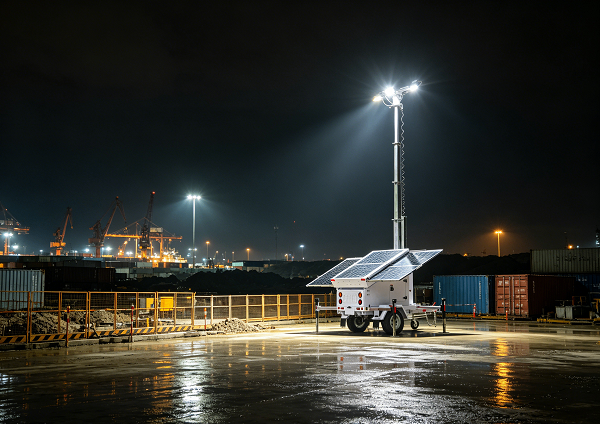
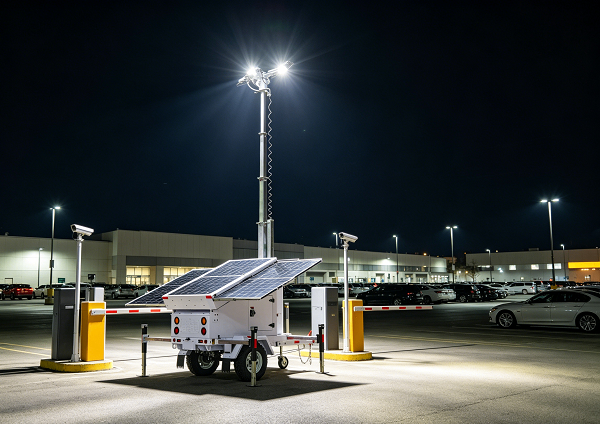
Lighting Performance: Lumens, Optics, and CoverageBrightness is the most visible spec, but it is only part of the story. Lumen output. For large‑scale projects, you need substantial illumination. Our 200W MST mobile solar light tower delivers 25,000–30,000 lumens, providing coverage suitable for parking lots, construction zones, and perimeter security applications. Larger systems can reach 96,000 lumens or more for expansive sites. Floodlights vs. spotlights. Floodlights (beam angle >120°) are ideal for wide‑area diffused lighting—construction sites, parking lots, and general work areas. Spotlights (beam angle 30°–60°) are designed for long‑distance, precise projection—perimeter security, high‑rise facades, and targeted work zones. Uniformity and glare. A photometric plan is essential. Using software like DIALux or AGi32, a supplier should provide a layout proposal showing average lux, minimum lux, and uniformity results. This ensures there are no dark zones and that glare is minimized for both workers and security cameras. Key question: Has the supplier provided a site‑specific photometric plan, or are they relying on generic assumptions? Runtime and Battery Autonomy: Matching Energy to DemandSolar lighting systems must operate through the night—and through consecutive cloudy days. Autonomy. Industry best practice targets three to five nights of autonomy for critical infrastructure and remote sites. For a large‑scale project, autonomy ensures the system remains operational during extended periods of low sunlight without manual intervention. Dimming profiles. Our mobile solar towers do not come with a factory‑set dimming schedule. Instead, the operating profile is fully user‑programmable — operators can configure the lighting schedule to match site‑specific requirements. Options include full brightness from dusk until dawn, dimming during low‑activity periods, timed shut‑off, or any custom profile that balances illumination coverage with battery autonomy. This flexibility ensures that each project gets exactly the runtime profile it needs. Battery chemistry. Gel lead‑acid batteries offer reliable performance in extreme temperatures and are often the more effective solution in sub‑freezing conditions. For standard applications, lithium‑ion (LiFePO4) provides longer cycle life and higher energy density. Key question: What is the system's actual runtime at full brightness, and how does the dimming profile affect performance? >Structural Design: Mast Height, Wind Load, and DurabilitySolar light towers operate outdoors, often in harsh conditions. Structural integrity is non‑negotiable. Mast height. Our standard MST product offers a maximum mast height of 20 feet, providing adequate coverage for most large‑scale applications. Taller masts (25–30 feet) may be required for very large areas like ports or container yards. Wind load. Solar panels add significant wind exposure. The vendor should provide wind‑load calculations or supporting documentation that matches the project location, pole height, fixture, panel size, and mounting configuration. For public projects or engineered sites, do not rely on generic assumptions. Compliance with IBC (International Building Code) and ASCE 7 standards for wind, snow, and seismic loads is essential. Mobility. For large‑scale projects that require frequent repositioning, look for trailer‑mounted configurations with sturdy wheels, standard tow hitches, and easy setup. A well‑designed unit should allow one person to deploy in under 15 minutes. Key question: Are wind‑load calculations provided for the specific configuration and location? Financial Analysis: Total Cost of OwnershipThe upfront cost of solar is higher than diesel—but the lifecycle savings are substantial. Diesel vs. solar TCO. A solar tower saves an average of 7 gallons of diesel fuel every day. At the current national average diesel price of approximately $4.67 per gallon, that equates to over $32 in direct daily savings per unit. For projects in higher-cost regions like California, where diesel prices exceed $5.50 per gallon, the daily savings can reach nearly $40 per unit. Over a standard 10‑year equipment lifespan, solar provides a 15% to 40% Total Cost of Ownership (TCO) advantage. Remote site fuel costs. At remote mine sites, delivered fuel cost rises significantly above pump price once transport surcharges, handling, and service vehicle costs are factored in. A diesel light plant at a remote site consumes 1.5–3 litres per hour—over 30 days, that is 540 to 1,080 litres per unit that must be delivered. Solar eliminates this entirely. 30% ITC tax credit. Commercial solar lighting systems qualify for the 30% Investment Tax Credit under Section 48E. To qualify, projects must either be placed in service by December 31, 2027, or begin construction by July 4, 2026. Additional bonus credits—up to 10% for domestic content and up to 10% for energy communities—may apply. Key question: Have you factored in the ITC credit and remote fuel delivery costs into your comparison? Supplier Evaluation: Beyond the Spec SheetNot all suppliers deliver the same level of engineering support. Photometric planning. A reputable supplier should provide a site‑specific lighting plan using industry‑standard software like DIALux or AGi32. This validates pole heights, spacing, and uniformity before a single tower is purchased. Remote support. We provide programming guidance, training support, and ongoing remote technical assistance, along with comprehensive support to help ensure your system performs as specified. Depending on project size and scope, we may also provide on-site support when appropriate. Warranty and certifications. Look for UL 1598 (luminaire) and UL 1310 (power unit) certifications. Battery warranties typically range from 5 years (gel lead‑acid) to 10 years (LiFePO4). LED fixtures are rated for 50,000+ hours. Key question: Does the supplier provide photometric planning, remote support, and full warranty documentation? Solar Lighting for a Large‑Scale Mining ProjectA mining operation in the western United States needed to light a 15‑acre equipment yard and haul road for night shifts. The site was 80 miles from the nearest fuel terminal, with winter temperatures dropping below -20°F. The project deployed 12 mobile solar light towers (200W MST configuration) with gel lead‑acid batteries rated for -40°F operation. Each tower delivered 25,000–30,000 lumens, covering approximately 15,000–25,000 square feet per unit. Results:
The towers remained operational through three consecutive cloudy days—thanks to 3‑night battery autonomy. The site superintendent reported that illumination quality exceeded the previous diesel system, and the lack of generator noise improved communication and safety. Summary Checklist for Large‑Scale Solar Light Tower Procurement
Conclusion: Choose Wisely, Light ConfidentlyLarge‑scale projects demand more than bright lights—they demand reliable, cost‑effective, and durable lighting systems that perform day after day, night after night. Solar light towers deliver that performance while eliminating fuel logistics, reducing maintenance, and qualifying for federal tax credits. The key is to evaluate each project on its own terms: site access, runtime requirements, weather exposure, and financial constraints. With the right configuration—and the right supplier—solar lighting is not just an alternative to diesel. It is the superior choice. Ready to specify solar lighting for your next large‑scale project? Contact us for a free site assessment and photometric plan. References
Most Popular
Industry News
The Basics
Solar FAQs
Inspiring Projects
Applications of Solar Lighting
|
ArchivesNo Archives Categories
Want More Info? |
LATEST NEWS & ARTICLES