Emergency Solar Lighting Tower: Rapid-Deploy Illumination for Crisis ResponsePosted by Stephen Shickadance in Most Popular. Industry News. The Basics. Applications of Solar Lighting.When every minute counts, solar-powered light towers deliver instant, fuel‑free illumination — without grid dependency, without noise, and without the logistical nightmare of diesel. The Golden Hour: Why Lighting Determines Crisis OutcomesIn large‑scale emergencies, the first 60 minutes — the “golden hour” — determine whether a crisis stabilizes or spirals out of control. During this critical window, coordinated emergency response lighting is not just equipment; it is an operational lifeline.
Disasters — whether hurricanes, wildfires, floods, or earthquakes — trigger a domino effect of systemic failures:
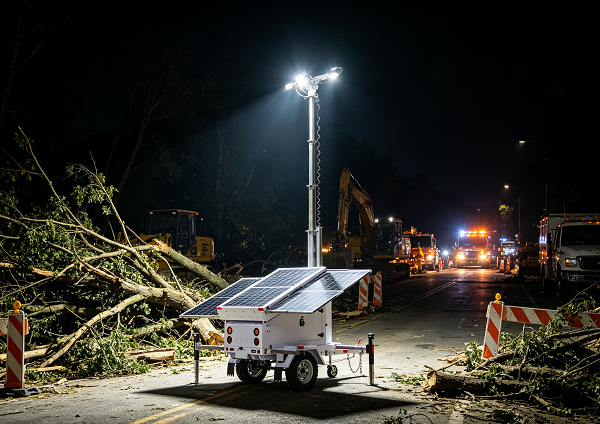
Without structured disaster recovery security solutions, the environment becomes a liability. Utility crews often find themselves forced to work in pitch‑black, unsecured zones — actively endangering personnel already operating under extreme physical and mental stress.
Common Use Cases for Emergency Solar Lighting TowersVersatile and highly portable, rapid-deploy solar light towers adapt to nearly every emergency and temporary lighting scenario:
The Diesel Problem: Fuel Logistics That Fail When You Need Them Most Traditional diesel light towers have been the default for emergency lighting, but disasters expose their critical vulnerabilities.
Fuel logistics frequently fail during natural disasters because of blocked roads or contaminated supplies. When every minute counts, waiting for a fuel delivery that may never arrive is not an option. In 2022 alone, generators and light towers on U.S. wildfires consumed nearly 2 million gallons of diesel fuel, costing $8.3 million — equivalent to 20,204 metric tons of CO₂. Beyond fuel availability, diesel towers introduce:
For emergency responders working in chaotic environments, these are not minor inconveniences. They are operational failures waiting to happen. The Solar Solution: Off‑Grid Illumination That Never Goes DarkModern emergency solar lighting towers are self‑contained, portable systems that operate independently of the failing local grid, ensuring that the recovery effort never goes dark. They harvest energy during the day and store it in high‑capacity batteries for all‑night operation. Rapid Deployment — Measured in Minutes, Not HoursIn a crisis, time is the enemy. Solar light towers can be deployed within minutes. Most systems feature trailer‑mounted designs with telescopic masts that reach full height in seconds. A single person can position the tower, raise the mast, and activate the lights without special tools, training, or external support. Zero Fuel, Zero LogisticsSolar towers eliminate the need for fuel deliveries entirely. There is no fuel to transport, no fuel to store, and no fuel to steal. Once deployed, they operate autonomously — charging during daylight and illuminating through the night — without any ongoing logistical support. For disaster zones where roads are impassable and fuel supplies are contaminated or unavailable, this independence is not a convenience. It is a requirement. Silent, Emission‑Free OperationUnlike diesel generators that run at 70–85 dB, solar towers operate in complete silence. This allows emergency personnel to communicate clearly, hear survivors calling for help, and maintain situational awareness without the drone of engines. Zero emissions also mean no exhaust fumes in evacuation shelters, medical triage areas, or confined spaces where air quality is already compromised. Instant‑On IlluminationStandard lighting often requires warm‑up periods or complex wiring. In a crisis, that delay is unacceptable. Solar towers utilize high‑efficiency LED arrays that reach full brightness immediately. This instant visibility transforms a chaotic debris field into a controlled workspace, allowing medical teams to perform triage and engineers to identify structural weaknesses without delay. Technical Specifications: What Emergency Responders Need to KnowNot all solar lighting towers are created equal. For mission‑critical emergency applications, look for these specifications: High‑Output LED Illumination
Battery and Autonomy
For extended cloudy conditions, intelligent control systems manage power usage to maximize runtime. The operating profile is fully user‑programmable — operators can configure the lighting schedule to match site‑specific requirements, including full brightness from dusk until dawn, dimming during low‑activity periods, timed shut‑off, or any custom profile. Structural Durability
Ease of Deployment
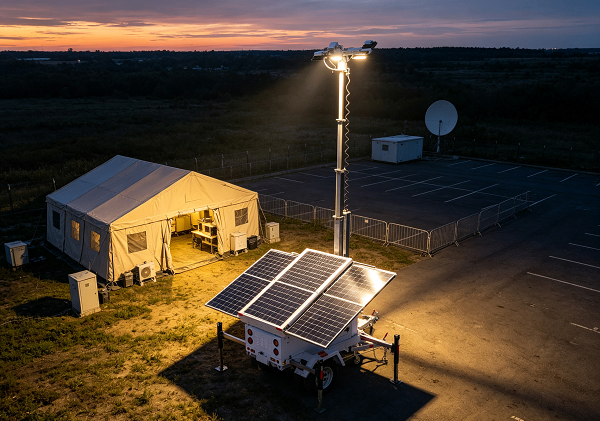
Where Solar Towers Make the DifferenceHurricane ResponseWhen Hurricane Harvey struck Texas, a small town deployed portable solar light towers in under 30 minutes. Even as evacuees arrived late into the night, the well‑lit paths helped them find their way to safety. The town didn’t have to deal with the noise and mess of diesel‑powered generators, and residents appreciated how the lights created a sense of calm amidst the chaos. Wildfire OperationsWildfires in Central and West Texas have been getting worse. When smoke is thick and power is out, people can easily get lost or disoriented. Solar floodlights provide fire crews, evacuees, and temporary shelters with reliable lighting, even in areas where the grid simply isn’t accessible. Earthquake ZonesFollowing the 2023 earthquakes in Turkey, solar was quickly put to work, providing search and rescue teams with light and enabling survivors to charge their phones. Students of solar from across Turkey put their skills into action to help those caught up in the disaster. Utility RestorationEmergency repair solar‑powered light towers are engineered for critical infrastructure restoration, disaster recovery, and urgent repair operations. They provide instant, powerful LED illumination for nighttime emergency scenes, ensuring utility crews can work safely through the night. Evacuation Routes and SheltersPortable solar light towers illuminate evacuation routes, shelters, and medical facilities during emergencies. They can be set up quickly and are powered entirely by the sun — meaning no fuel and no running out of power in the middle of a disaster. The Financial Case: Solar vs. Diesel for Emergency ResponseWhile solar towers represent a larger investment upfront, they deliver significant long‑term savings:
Solar towers typically pay for themselves within 1–3 years through eliminated fuel and maintenance costs. For emergency response agencies operating on tight budgets, this long‑term cost advantage is critical. Market Trends: Solar Is the Fastest‑Growing SegmentThe mobile solar light tower market is expanding rapidly, driven by:
Their portability, rapid deployment capability, and tactical suitability for emergency and disaster relief operations have driven significant uptake across mission‑critical applications. Solar light towers are becoming highly sought after due to their energy efficiency, minimal operational costs, and versatility. When Disaster Strikes, Light Is a LifelineIn the chaos of a natural disaster, reliable illumination is not a luxury — it is a lifeline. Solar light towers deliver instant, fuel‑free, grid‑independent lighting that keeps rescue operations moving, shelters safe, and recovery efforts on track. They deploy in minutes, not hours. They run silently, without emissions. And they never run out of fuel — because they don’t need any. For emergency managers, first responders, and disaster recovery teams, the choice is clear: diesel is a liability waiting to fail. Solar is a solution that never goes dark. References
Most Popular
Industry News
The Basics
Applications of Solar Lighting
|
ArchivesNo Archives Categories
Want More Info? |
LATEST NEWS & ARTICLES