Solar Lighting for Security Cameras, License Plate Readers, and Perimeter VisibilityPosted by Stephen Shickadance in Most Popular. Industry News. How Solar Lights Work. Applications of Solar Lighting.Visibility Is the Foundation of All Site SecurityEvery security system—whether IP surveillance cameras, automatic license plate readers (LPRs), manned security patrols, or perimeter motion sensors—relies on one non-negotiable factor: reliable visibility. A facility can install high-resolution cameras, modern access gates, and advanced detection hardware, yet still suffer from unusable footage if lighting is uneven, flickering, or obscured by shadows. For security managers and facility owners tasked with protecting warehouses, industrial yards, commercial parking lots, and distribution centers, lighting is never an afterthought. It is the backbone of consistent surveillance.
Traditional grid-powered lighting often struggles to meet strict security camera requirements due to high installation costs, fixed wiring limitations, and inconsistent voltage output. Today, engineered solar lighting has become the preferred solution for secure off-grid illumination. Unlike generic outdoor lights, professional solar lighting systems are engineered to optimize camera clarity, stabilize LPR capture rates, and maintain clear perimeter visibility 24/7. In this guide, we break down how purpose-built solar lighting elevates surveillance performance while aligning with official crime prevention design standards. Lighting Is an Integral Part of Your Camera System, Not an Add-OnMany commercial facilities follow a flawed construction sequence: lay out electrical infrastructure first, mount poles and fixtures arbitrarily, and then install security cameras afterward. This outdated workflow inevitably creates irreversible security flaws, including harsh glare, dark blind spots, uneven illuminance, and washed-out camera footage. When lights are misaligned with camera angles, even 4K surveillance hardware fails to capture clear facial features, vehicle details, and suspicious movement at night.
Effective security design flips this sequence. Top-tier facility managers first map camera fields of view, vehicle entry gates, pedestrian walkways, high-risk corners, and perimeter boundaries before finalizing light pole placement. Solar lighting excels in this optimized workflow because it requires no underground trenching, fixed power cables, or reliance on local utility grids. For remote storage yards, expansive parking lots, and isolated perimeter zones with no existing electrical infrastructure, solar lights deliver plug-and-play illumination exactly where cameras need clarity the most. Well-designed solar lighting eliminates reflective glare directed toward camera lenses, maintains uniform brightness across pavement surfaces, and removes shadowed hiding spots that compromise surveillance quality. Instead of treating lights as simple brightness tools, security teams should view solar fixtures as calibrated accessories that maximize the return of every surveillance device on-site. All-Night Consistent Brightness: Non-Negotiable for Security ReliabilityWhen cameras are installed after the lighting layout is already fixed, several problems emerge:
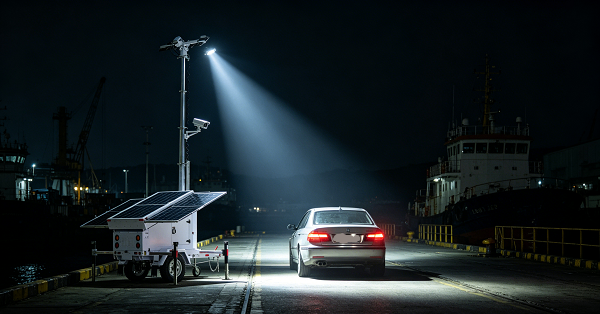
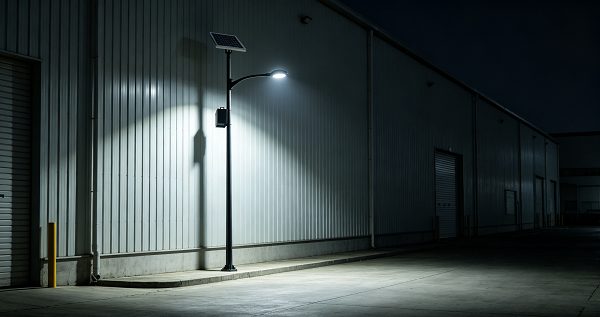
Security incidents never follow business hours. Trespassing, cargo theft, vandalism, and unauthorized vehicle access frequently occur during overnight shifts, early morning arrivals, and late-night delivery windows. For warehouses, logistics hubs, and large commercial parking lots, security lighting cannot rely on aggressive dimming schedules that sacrifice visibility to save battery power. Generic solar street lights automatically dim to minimal brightness after midnight, which drastically weakens camera performance during high-risk overnight hours. Overly dim lighting blurs license plate characters, distorts human silhouettes, and creates inconsistent exposure for motion-triggered camera recordings. Purpose-engineered solar security lighting from Ample features customizable dimming profiles, allowing facility managers to lock in stable, camera-friendly brightness throughout the entire security window. Whether at 2 a.m. or 4 a.m., fixtures maintain steady illumination to ensure continuous footage clarity. Solar lighting systems are self‑contained, requiring no trenching or grid connection. This freedom of placement means security lighting can be deployed exactly at the intersection of camera fields of view and high‑risk zones, without compromise. Follow CPTED Principles to Strengthen Perimeter DefenseProfessional security design consistently adheres to CPTED (Crime Prevention Through Environmental Design), an official framework recognized by the U.S. Office of Justice Programs (OJP) and the LAPD Commercial Crimes Division. According to federal public safety research, optimized visibility and natural surveillance rank as the most cost-effective crime deterrents for commercial properties. CPTED core guidelines emphasize eliminating isolated shadow zones, delivering uniform lighting distribution, and minimizing visual obstructions to reduce criminal concealment opportunities. Poor lighting design creates sharp contrast between blinding bright zones and pitch-black shadows—an issue proven to reduce camera clarity and embolden trespassers. Our solar lighting strictly follows CPTED engineering standards to deliver smooth, balanced illumination across parking aisles, boundary fences, entry gates, and blind corners. Every fixture uses precision optical lenses to cast targeted downward light, eliminating upward light pollution and camera glare. This compliant lighting layout enhances natural surveillance for both manned guards and automated surveillance hardware. Solar Lighting Design Questions for Security Use CasesWhen designing a solar lighting system for security applications — especially when cameras and LPRs are involved — ask the following technical questions: Fixture Optics and Light DistributionWhat is the beam angle and distribution pattern of the fixture? Wide floods may be suitable for open parking areas, but narrow spot optics may be required for long‑range perimeter coverage or license plate capture. The choice affects both camera performance and light trespass. Pole Height and Mounting DirectionWhere will each pole be placed relative to camera positions? How high will the fixture be mounted? Different security zones require different pole heights. For LPR applications, mounting height affects the angle at which light hits license plates. Expected Illumination at Camera TargetsWhat is the lux level at the specific surfaces cameras are monitoring — not just on the ground, but vertically at face height or plate height? The Illuminating Engineering Society (IES) recommends a minimum horizontal illuminance of 2 lux in parking lots, but for surveillance in critical areas, standards often call for 30–50 lux to ensure clear visibility of faces and license plates. Glare Toward CamerasDoes the fixture create glare toward the camera? Direct light entering the lens causes blooming — the washout of details in the bright area — and forces the camera to auto‑expose downward, darkening everything else. Low‑glare optics, shielded backlight, and careful fixture tilt are essential for camera‑compatible lighting. License Plate VisibilityDoes the design support license plate visibility at entrances, or only general area lighting? LPR cameras require specific lighting conditions: adequate vertical illuminance (often 50 lux or higher), appropriate color temperature, and careful control of angle to avoid plate glare. The illumination angle for LPR applications typically falls between 40° and 90° for short‑distance, wide‑area illumination, and the camera-to-road angle should be kept under 30° for optimal plate capture. Full‑Window BrightnessWill the system maintain a set brightness level for the entire security window — typically dusk to dawn — regardless of season or consecutive overcast days? Security incidents have no schedule. Your lighting should not either. Solar Lighting for Perimeter VisibilityPerimeter security presents unique lighting challenges. Boundaries are often long, remote from grid power, and require consistent illumination to detect intrusions. Traditional trenching along a property line can be prohibitively expensive — easily exceeding $50–$150 per linear foot. Solar lighting solves this by placing self‑contained fixtures at intervals along the perimeter without trenching. Key design considerations for perimeters include:
Solar bollard lights can serve as active perimeter definition markers, clearly delineating property boundaries and access control zones after dark. Site Planning Recommendations For security managers and facility owners planning a new lighting installation:
Design Lighting for Security, Not Just IlluminationThe best security cameras in the world are only as effective as the lighting that supports them. A dark or poorly designed lighting layout creates blind spots, degrades footage quality, and undermines the entire surveillance investment. Solar lighting offers a powerful advantage for security applications: the ability to place fixtures exactly where cameras need them, without the cost and constraints of trenching and grid connection. When designed with camera locations, LPR requirements, and CPTED principles in mind, solar lighting transforms from a simple utility into a strategic security asset. Send your camera map and parking lot layout. We can design solar lighting around entrances, perimeter areas, and camera fields of view. References
Most Popular
Industry News
How Solar Lights Work
Applications of Solar Lighting
|
ArchivesNo Archives Categories
Want More Info? |

LATEST NEWS & ARTICLES