Airport Adjacent Properties & World Cup Traffic: Solar Lighting as a Security Advantage during the 2026 TournamentPosted by Stephen Shickadance in Most Popular. Industry News. Inspiring Projects. Applications of Solar Lighting.The 2026 FIFA World Cup is not just a sporting event — it is the world’s largest travel surge, and it is happening now. For hotels near major airports like LAX, Newark Liberty, Philadelphia International, and Dallas/Fort Worth, the next five weeks will test every aspect of operations. Guest rooms will be sold out. Parking lots will be at capacity. And every traveler arriving from overseas will be exhausted, jet‑lagged, and hyper‑alert to their surroundings. In this environment, the difference between a five‑star review and a one‑star nightmare can be as simple as a well‑lit parking lot. Guests who feel safe return. Guests whose rental cars are broken into — or who feel uneasy walking across a dark lot — never come back, and they tell thousands of others online.
Solar light towers offer airport‑area hotels a fast, visible, and cost‑effective way to deliver on the most basic guest promise: you are safe here. This article shifts the focus from technical specifications to the guest experience, reputation management, and the quiet power of light as a psychological safety net. The Guest’s First Impression Happens in the Parking LotA World Cup traveler landing at LAX after a 12‑hour flight has one goal: reach the hotel, check in, and sleep. But the journey does not end at the terminal. They collect luggage, board a shuttle or rental car, and arrive at the hotel — often after dark. The first thing they see is the parking area.
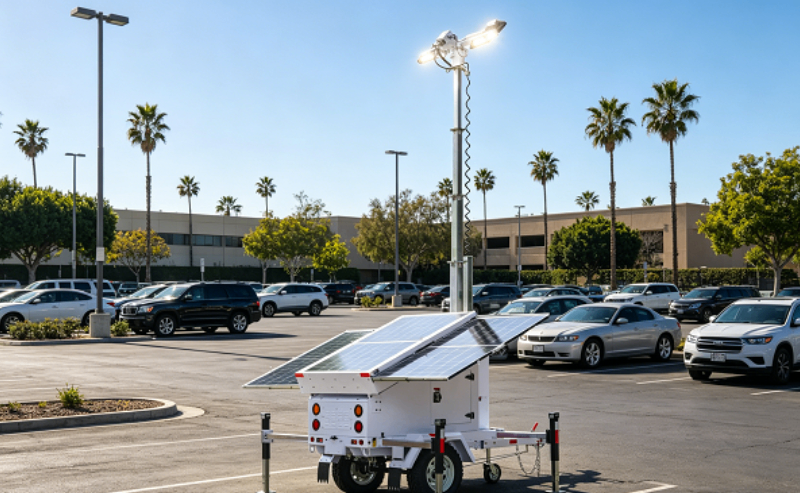
If that area is dark, shadowed, or unevenly lit, the guest’s brain automatically shifts into high alert. Anxiety rises. Perceived risk spikes. Even if no crime occurs, the feeling of unsafety damages the guest’s entire stay. Conversely, a bright, uniform, well‑lit parking lot communicates competence, care, and control. The guest exhales. They feel welcomed, not warned. Research consistently shows that improved lighting reduces the fear of crime more than it reduces crime itself — and that reduction in fear directly correlates with guest satisfaction and return intent. For airport‑area hotels during the World Cup, where every guest is already stressed by travel, the psychological benefit of excellent lighting is not a luxury. It is a competitive necessity. The Reputation Risk of a Dark Lot During Peak OccupancyOnline reviews have killed hotels over parking lot security. A single review that reads “The hotel was fine, but the parking lot was so dark I was afraid to walk to my car” can cost hundreds of thousands in future bookings. During the World Cup, when every hotel is at 100% occupancy, the risk multiplies. A dark lot combined with a theft or a minor accident becomes a viral story. Consider the scale: FIFA expects more than five million fans to attend matches in person, with roughly 40% of attendees arriving from outside the United States. Many of those international travelers will rent cars at the airport and drive directly to nearby hotels. They are carrying passports, cash, electronics, and match tickets — high‑value targets for thieves. Airport‑adjacent hotels are already high‑risk environments for vehicle break‑ins because of the transient nature of guests. During the World Cup, with crowds overwhelming local law enforcement and security teams stretched thin, a poorly lit lot is an invitation. One smashed window, one stolen suitcase, and the hotel’s reputation on platforms like TripAdvisor and Google Reviews takes a permanent hit. Solar light towers provide an immediate, visible upgrade that guests notice and appreciate. When a hotel invests in bright, consistent, all‑night lighting, it signals that guest safety is a priority. That signal translates directly into higher review scores, better word‑of‑mouth, and repeat business — not just during the World Cup, but for years afterward. How Solar Lighting Creates a “Passive Deterrent” Without Guard LaborMost airport hotels cannot afford to station security guards at every corner of their parking lot. Guards are expensive, scarce during high‑demand events, and often ineffective if they are not constantly moving. Solar light towers offer a different approach: passive deterrence through environmental design. The principle is simple. Criminals avoid well‑lit areas because they know they can be seen. A bright, uniform lighting layout eliminates hiding places, increases the perceived risk of getting caught, and forces potential offenders to move elsewhere. This is not speculation — it is the foundation of Crime Prevention Through Environmental Design (CPTED), a strategy adopted by law enforcement agencies worldwide. Solar light towers are especially effective for passive deterrence because they are tall (15–20 feet masts), which casts light over a wide area without creating harsh shadows. Unlike traditional pole lights that may be spaced too far apart, solar towers can be placed exactly where risk is highest: near stairwells, behind dumpster enclosures, at the far end of overflow parking areas, and along pedestrian walkways from the lot to the lobby. And because solar towers require no trenching or grid connection, they can be installed in locations where permanent lighting was previously impossible or cost‑prohibitive. A hotel that installs solar towers ahead of the World Cup is not just adding light — it is redesigning the security geometry of its property. Silent, Emission‑Free Lighting Enhances the Guest ExperienceDiesel light towers — the traditional alternative for temporary or off‑grid lighting — come with two features that hotel guests despise: noise and exhaust. A diesel generator running all night in a hotel parking lot produces a constant 70–85 dB hum, audible inside guest rooms facing the lot. Complaints pour in. Sleep is disrupted. Reviews plummet. Solar light towers are completely silent. There is no engine, no generator, no moving parts — only the soft hum of LEDs, which is imperceptible even a few feet away. For a hotel near LAX or Newark, where guests are already fighting jet lag and time‑zone confusion, a silent night is priceless. Solar towers also produce zero emissions. No diesel smell wafts into the lobby or guest rooms. No particulate matter settles on parked cars. For hotels with ESG commitments or LEED certification, solar lighting contributes directly to sustainability goals. And during the World Cup, when the world’s media is watching, a hotel that can honestly claim “100% solar‑powered parking lot lighting” earns positive press coverage and guest goodwill. From “We Need Light” to “We Have Light” in HoursThe World Cup has already started. Airport‑area hotels cannot wait eight weeks for trenching permits, utility coordination, and electrical inspections. Solar light towers deploy in hours, not weeks. A trailer‑mounted solar tower arrives on a flatbed, is positioned by a pickup truck, and is operational within 15 minutes. For a hotel manager facing a sold‑out week and an unlit overflow lot, this speed is transformative:
Hotels can lease solar towers for the tournament period or purchase them as a permanent security upgrade. Either way, the deployment timeline is measured in days, not months. This agility is essential during a global event where conditions change daily and security needs evolve overnight. The ITC Tax Credit Makes Solar Affordable — Even for Temporary Installations Commercial solar lighting systems qualify for the 30% federal Investment Tax Credit (ITC) under the Inflation Reduction Act. For a hotel purchasing solar towers, that is a direct 30% reduction in net cost. For hotels that lease solar towers during the World Cup, the tax credit may not apply directly — but the lease payments are fully deductible as operating expenses. Either way, the cost of solar lighting is far lower than the cost of a single liability lawsuit or a sustained drop in online ratings due to a dark‑lot incident. Solar Lighting as a Permanent AssetThe World Cup lasts five weeks. But the security and reputation benefits of solar lighting last a decade. Hotels that invest in solar towers for the tournament are not throwing money at a temporary problem. They are acquiring a permanent asset that:
After the World Cup ends, the same solar towers continue protecting guests, staff, and vehicles for years. They become part of the hotel’s standard security infrastructure — and a selling point in marketing materials. Our parking lot is lit by 100% solar power, keeping you safe and our carbon footprint low. What Airport‑Area Hotels Should Ask a Solar Lighting Vendor If you are a hotel manager or owner near LAX, Philadelphia International, Newark Liberty, Dallas/Fort Worth, or any other World Cup hub, here is what to ask potential solar lighting suppliers:
Light Is a Promise. Keep It.The 2026 World Cup has turned airport‑area hotels into the front line of guest security. Every night, thousands of exhausted, distracted travelers will walk across your parking lot. Their first impression, their safety, and their online review depend on one factor: visibility. Solar light towers deliver bright, silent, emission‑free, theft‑proof lighting that deploys in hours, not weeks. They reassure guests, deter criminals, and protect your reputation. And with the 30% federal ITC tax credit, they are more affordable than ever. Do not wait for a guest complaint or a theft incident. Light your lot now. Your guests — and your five‑star ratings — will thank you. Sources: [1] FIFA World Cup 2026 – Official Match Schedule & Format. www.fifa.com [2] KTLA / Sports Illustrated: “2026 World Cup: The Most‑Watched Sporting Event in History?” Barnaby Lane, 2026 [3] Merca2.0: “FIFA estimates 6.5 million tourists at the World Cup: 40% of attendees will be international travelers.” May 5, 2026 [4] Bluewin / Japan Today: “The World Cup is coming — but the airport is already completely overloaded.” June 2, 2026 [5] AS.com: “The World Cup is coming, but one U.S. city already looks overwhelmed.” May 28, 2026 [6] Malay Mail: “Ninety‑five thousand cars, endless honks and unfinished trains — LAX braces for World Cup madness.” May 27, 2026 [7] Houston Public Media: “Houston is installing 300 solar‑powered lights along the Columbia Tap Trail.” June 1, 2026 [8] KHOU 11: “New solar lights illuminate Columbia Tap Trail ahead of World Cup.” June 1, 2026 [9] Stiver Engineering: “FIFA World Cup 2026: Engineering Texas For The World Stage.” 2026 [10] NBC Los Angeles: “Men caught stripping, cutting copper wire from streetlight near LAX.” August 5, 2025 [11] Internal Revenue Service, Section 48 Investment Tax Credit (Inflation Reduction Act)
Most Popular
Industry News
Inspiring Projects
Applications of Solar Lighting
|
ArchivesNo Archives Categories
Want More Info? |
LATEST NEWS & ARTICLES