The Role of Solar Towers for Mining Operations in Remote RegionsPosted by Stephen Shickadance in Most Popular. Industry News. Inspiring Projects. Applications of Solar Lighting.Remote mining operations operate in some of the harshest environments on Earth—far from power grids, with rough terrain, extreme temperatures, dust, and limited logistics. For mining companies, reliable 24/7 lighting is not just convenient; it is essential for safety, productivity, and compliance. Traditional diesel light towers have long been the default, but they come with crippling flaws: high fuel costs, constant maintenance, noise, emissions, and risky fuel delivery to isolated sites. Today, high-performance LED solar light towers have emerged as the rugged, reliable, and future-proof solution—purpose-built to overcome the unique challenges of remote mining.
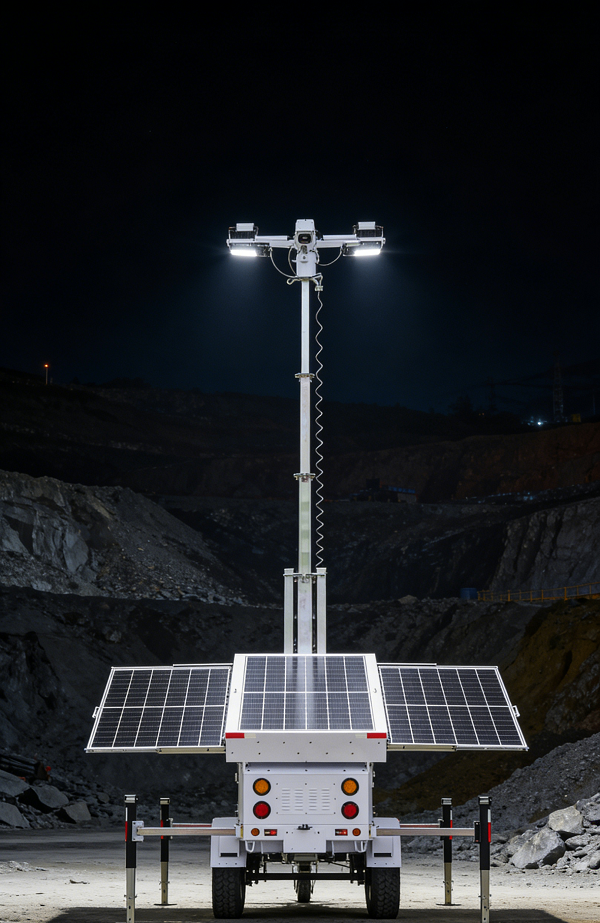
Built for extreme durability, our solar light towers are engineered from the ground up to perform in mining conditions that would disable ordinary equipment. Every component is selected and tested for dust resistance, vibration tolerance, water protection, and stability on uneven ground. Unlike diesel units, which require frequent refueling and mechanical repairs in hard-to-reach locations, solar towers deliver off-grid autonomy, minimal maintenance, and silent, emission-free operation—critical for mines where logistics and downtime directly impact profitability. At the core of our mining-grade solar light tower is a high‑efficiency monocrystalline solar system, delivering up to 23% energy conversion. This ensures consistent charging even in cloudy conditions, high altitude, or short winter days—common in remote mining regions. Our solar panels are mounted at optimal angles to ensure maximum energy capture—critical for remote construction sites or emergency response scenarios where grid access is unavailable. Paired with deep‑cycle, climate‑optimized batteries, the system provides 3–5 full nights of uninterrupted lighting without recharging. An intelligent charge controller prevents overcharging and deep discharge, extending battery life to 5–7 years and reducing long-term service costs.
Structural ruggedness defines the design. A heavy-duty steel frame with corrosion-resistant coating supports the solar array, battery bank, and mast while remaining trailer-mountable for easy transport across rough mining roads. The telescopic mast extends up to 30 feet, covering 30,000–50,000 square feet per unit—eliminating dark zones around haul roads, stockpiles, loading zones, and worker stations. Wide stabilizing legs provide secure footing on uneven, rocky, or soft terrain, reducing tip risk in high winds. Deployment takes hours, not days, with no wiring, trenching, or grid connection—ideal for dynamic mining sites that shift as extraction progresses. A fully integrated, plug-and-play system architecture simplifies operation. With no complex engines, fuel lines, or moving parts, our solar light towers drastically cut maintenance compared to diesel. Daily upkeep is limited to occasional panel cleaning; there are no oil changes, filter replacements, or engine repairs. This is transformative for remote mines, where service labor and parts are expensive and downtime is costly. Reduced mechanical failure means more consistent lighting, safer night shifts, and higher operational continuity. The Mining Challenge: Lighting Without InfrastructureRemote mine sites often lack grid power. Diesel generators and light towers have been the default solution, but they come with severe operational drawbacks:
Mining needs a better way. Solar is that way. Why Solar Towers Are Built for MiningOur mobile solar light towers are engineered to withstand the same punishing conditions as mining equipment — and to operate completely independently of fuel supply chains. 1. True Off-Grid Independence
For mines in the Australian Outback, Chilean highlands, Canadian tundra, or African bush, this independence transforms lighting from a logistical headache into a set-and-forget asset. 2. Extreme Durability
3. Silent, Emission-Free Operation
For underground mines, eliminating diesel exhaust from lighting improves air quality and reduces ventilation costs. 4. Minimal Maintenance = Maximum UptimeDiesel towers demand oil changes, filter replacements, fuel system cleaning, and engine repairs. Solar towers have:
Result: Less downtime, lower labor costs, and more reliable illumination. Real-World Mining ApplicationsSurface Mining (Copper, Gold, Iron Ore)
Underground Mining
Exploration & Remote Camps
Processing Plants & Tailings Facilities
Frequently Asked Questions — Mining Edition Can solar towers handle 24/7 operations?Yes. With 3–5 nights of battery autonomy, solar towers support continuous night shifts. During daylight, the system recharges automatically. For extreme latitudes with limited winter sun, we can oversize the battery bank or supplement with wind/hybrid options. What about dust and dirt?All electrical components are fully sealed to IP65 or NEMA 4X standards. Solar panels are self-cleaning with tilt angles that shed dust. Routine wiping during safety inspections is sufficient. How do they perform in extreme cold?Gel lead-acid batteries operate reliably down to -40°C (-40°F). Can we move towers as mining progresses?Yes. Our towers are trailer-mounted with forklift pockets and lifting eyes. The mast extends up to 20 feet, allowing the fixtures to illuminate approximately 10,000–20,000 square feet per unit—helping eliminate dark zones around haul roads, stockpiles, loading zones, and worker stations. Does solar work on cloudy days?Yes. The battery bank stores 3–5 days of reserve power. The intelligent controller dims lights automatically to extend runtime during extended low-solar periods. Solar light towers are not just an environmental choice — they are a financial and operational imperative for modern mining.
Mining operations that switch to solar gain a competitive advantage: lower costs, higher reliability, and fewer logistical dependencies.
Most Popular
Industry News
Inspiring Projects
Applications of Solar Lighting
|
ArchivesNo Archives Categories
Want More Info? |

LATEST NEWS & ARTICLES